2025. 11. 11. 18:48ㆍWhat I like/Experience
남영야학, 공존을 위한 언어감수성 |신지영 교수 (고려대 국어국문학과)
Linguistic Sensitivity for Coexistence
A Review of Professor Shin Ji-young’s Lecture
This is a review of the final lecture of the 2025 Namyeong Night School (남영야학, Namyeong Yahak), "Language Sensitivity for Coexistence," by Professor Shin Ji-young of Korea University’s Department of Korean Language and Literature.
The lecture took place at the National Museum of Korean Democracy (민주화운동기념관, Minjuhwa Undong Ginyeomgwan), located in the former Namyeong-dong Interrogation Center (남영동 대공분실, Namyeong-dong Daegong Bunsil) - once a site of political oppression, now reborn as a space for remembrance and learning.
01. Introduction to the Lecturer
Professor Shin began by introducing herself — and immediately threw us a question:
“When you hear the phrase ‘Department of Korean Language and Literature (Gug-eo Gukmun-hak)’,
what image comes to your mind?”
If we pause and ask ourselves that question, " What kind of person do you imagine when you hear someone studies or teaches it?", most people probably visualize 'Literature'rather than 'Language'. They imagine someone a bit old-fashioned, who loves books and writes literary works. In fact, most of the audience gave the same answer.
However, Professor Shin’s major is not Literature, but Korean Linguistics, the study of the Korean language itself. She explained her reason for asking this opening question: last year, when author Han Kang was a Nobel Prize contender, several reporters called the professor for commentary. She realized then, "Even though almost every university in South Korea has a Department of Korean Language and Literature and I have significant media exposure, people still don't know what Korean Language and Literature truly is." Since then, she said, she begins her lectures with this question.
Professor Shin stated that Korean Linguistics covers five worlds:
the world of words,
the world of sentences,
the world of sound,
the world of meaning,
and the world of Pragmatics (화용, Hwayong).
Pragmatics is the study of how language operates in real-life contexts. For example, the sentence "I am hamburger" doesn't usually make sense. But in a restaurant, when someone says it to a waiter, everyone understands: it means “I ordered hamburger.” That’s pragmatics.
Hearing about those five linguistic worlds, how do you feel? Curious, or bored?
Most people think linguistics is dry and technical. So Professor Shin once asked herself:
“Why do people find linguistics boring?”
and then turned it around — “Why do I find this interesting?"
She found the answer in the keyword 'travel.' People love traveling — but she said she doesn’t necessarily enjoy physical travel. But studying language is like a different kind of travel. Travel is the act of seeking out places one hasn't seen before. Exploring unseen places, discovering hidden patterns, and observing worlds most people never notice. So she realized she had been traveling all along not through cities or countries, but through the landscape of language itself.
By simply changing the words, a boring term can become fascinating:
Linguist → Language Explorer
Lecture → Sharing of Expeditions
Theses, Book publications = Sharing travel memoirs
Are you ready to explore language? Let’s move to the next chapter.
02. Linguistic Sensitivity (언어 감수성, Eoneo Gamsuseong)
Have you ever heard the term 'Language Sensitivity'? I have heard it many times, but surprisingly, the person who coined this term was Professor Shin Ji-young herself.
She observed that around the early 2000s, people started talking frequently about skin, saying things like, "Your skin looks so good," or "You have porcelain skin!" Why did this sudden interest in skin occur? Her research found the answer: technology. the popularization of larger TVs and the start of HD broadcasting.
In South Korea, a 21-inch TV was considered large in the 1990s, and HD services began in 2001. As TVs got bigger and high-definition was introduced, people could see faces on screen much more clearly. Consequently, they became obsessed with skin quality. The change in technology literally altered our focus, our conversations, and ultimately, our language.
03. Why We Want to Speak Well
Professor Shin asked, "What are the two common wishes of all people?"
The first answer: to be happy.
The second: to speak well.
Then she asked again,
“Why do we all want to speak well?”
The answer, she said, is simple — because we want to be happy.
According to book 「Aging Well」, happiness is born from warm and genuine social relationships. And what is the tool that builds those relationships? It’s language. That is why we long to speak well — because through language, we connect, we belong, and we become a little closer to happiness.
04. How to Speak Well
So then, how can we speak well? Before answering that, we must first ask : Why do we speak at all? We speak because we want to be heard. Therefore, the key to speaking well is simple to speak from the listener’s point of view. When we speak, we should do so with the heart that says, “Please, listen to me.” And when we write, “Please, read what I wrote.”Because communication is, in the end, a process of narrowing the distance between the speaker and the listener.
05. The Reason Behind Koreans’ Deep Sense of Isolation
Professor Shin also addressed the high level of isolation in South Korea. The country, sadly, holds the highest suicide rate among OECD nations, and surveys asking, "Do you have friends or relatives you can rely on?" indicate that the Korean people have one of the weakest social relationship networks globally.
Why do Koreans feel so lonely? There are countless reasons, but one major reason lies in language. The closest relationships we have are with family and friends. While family is not something we choose, friends are. However, in Korea, the definition of a 'friend' is often limited to people of the same age. The scope of friendship is restricted by age.
When the law on standardizing age to international age was implemented, it seemed like a chance to break that age boundary. But in reality, nothing changed.

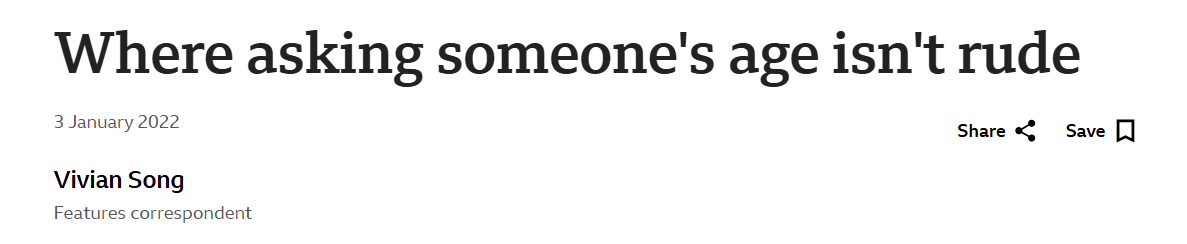
When Koreans ask about someone's age, people used to answer, “I’m 25 years old.” Now they say, “I was born in 2000.” The words changed, but the question remains: “몇 살이세요? (How old are you?)” Why do Koreans always ask this first?
In Korean, unless it’s a formal business setting, a term of address (호칭, hochingeo) is required in almost every interaction. It’s uncommon to call someone simply by their name unless you’re the same age. You need to know whether the person is older (언니 eonni / 누나 nuna) or younger. To choose the right title, you must know their gender and age. While gender is visible, age is not — which explains why asking someone’s age has become a normalized custom upon first meeting.
Moreover, Korean is a language deeply structured around politeness. In English, “you” can address anyone — a friend, a professor, even a president. But in Korean, calling a professor “너 (neo, you)” would be considered extremely rude.
This linguistic structure embeds age hierarchy and social distance into everyday speech. It shapes how we relate to others — often creating boundaries where warmth should exist.
Earlier, she reminded us that happiness comes from warm human relationships. Perhaps it’s no surprise, then, that so many Koreans feel lonely.
06. Reflection on the Lecture
I first began to think about language when I left school at twenty. Until then, my world was made up of peers my age and adults — no in-between. But once I stepped outside, I encountered relationships of many kinds.
As the youngest in my family, I always found it strange when someone called me 언니 (eonni, older sister). It wasn’t the word itself that felt uncomfortable, but the treatment that came with it. Why should I be given the first seat, the first bite, or the final say — just because I was born earlier than them?
After that, whenever I met someone younger, I asked them to just call me “ (ya, The words that friends of the same age use to call each other comfortably),” casually. But it didn't work at all. I think it just as I was uncomfortable being called 언니, they too were uncomfortable breaking the linguistic order they grew up in.
My interest in language deepened when I began noticing the subtle inequalities hidden within words. Words I once used casually turned out to carry prejudice, so I started choosing my language more carefully. Then I read a book, titled [ ]. This book that revealed how discrimination hides inside everyday expressions. That book made me realize that language is not just a tool for speaking.
Professor Shin’s lecture content aligns perfectly with this realization. Why does a linguist talk about loneliness and generational conflict, instead of grammar? Because language is not just about speech — it’s about connection.
The professor mentioned that she had prepared 300 pages but could not cover even half of it during the 90-minute lecture. I will now turn to her books to soothe that remaining sense of curiosity and regret.
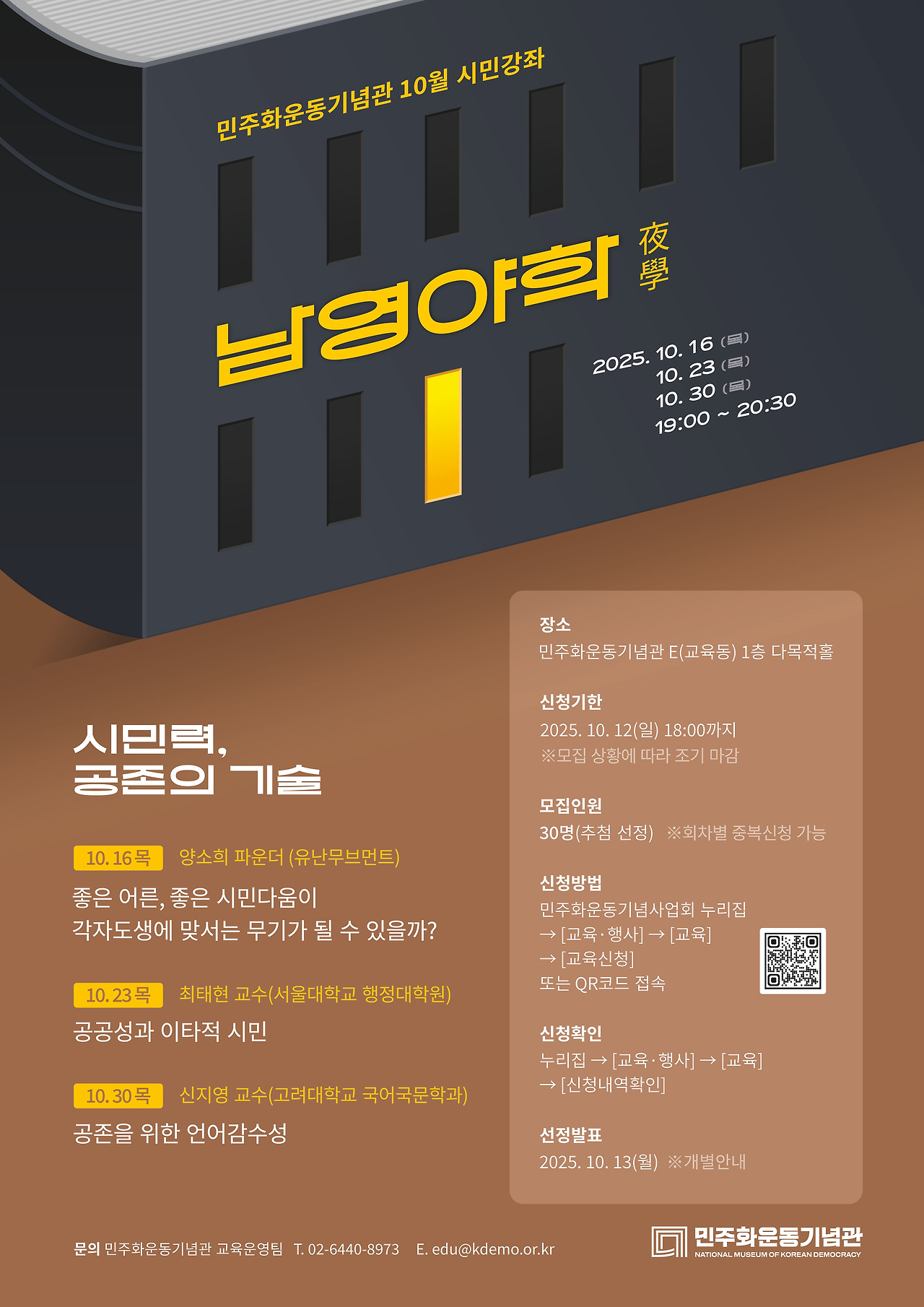
* This is the promotional poster for the lecture series.
National Museum of Korean Democracy October Citizen Lecture Series
Namyeong Night School : Citizen Power, The Art of Coexistence
The Namyeong Night School in October will explore 'Coexistence' as a fundamental civic competence. We aim to understand the necessity of coexistence for citizens living in a democratic society, and collaboratively explore what capabilities citizens must possess to live a harmonious life.
○ "Language needs a Refresh!"
Join Professor Shin Ji-young, who was the first to popularize the term 'Language Sensitivity' to the public, to learn about communication skills that narrow the distance in relationships. We will take time to reflect on our language habits and cultivate the Language Sensitivity required for coexistence as democratic citizens.
'What I like > Experience' 카테고리의 다른 글
| 서울문화예술교육센터 용산, [십장생 : 안녕의 풍경] 다 큰 어른이 그림책을 읽는 방법 후기 #그림책작가 (32) | 2024.11.18 |
|---|---|
| [번아웃 탈출 워크숍] 워크숍 마지막 회차, 바빴던 하루의 끝 잘 마무리 하기 (0) | 2022.10.13 |
| CMS 2022 - 1_04 : 아디다스 이진영 부장, 손 커밍데이와 멤버스위크 (0) | 2022.10.10 |
| CMS 2022 - 1_03 : LG전자 오혜원 상무, 금성오락관과 프리즈 아트페어 (0) | 2022.10.08 |
| CMS 2022 - 1_02 : 틱톡코리아 설윤환 매니저 (0) | 2022.10.07 |